Accretions and Dissipations:
Archipelago Thinking in Artistic Research
A forthcoming Jakarta conference on “archipelagic” and “island” metaphors for new forms of relational thinking shows that this once-fringe strand of philosophical, artistic, and activist discourse, rooted in Caribbean thinkers and contexts, has become a global framework. Nowhere is this more relevant than in the Asia-Pacific region, with its far-ranging and ever-moving cultural, linguistic, political, and historical diffusions and trajectories.
This presentation, part of a larger project titled “Theory for artistic research,” develops some implications of archipelagic philosophy through artistic practice, with at least three implications. First, it puts into practice the idea that musicking can be a form of thinking that produces types of knowledge less easily reachable by other research paradigms. Among other things, this is a “thought in motion” that I will characterise using the metaphor of “tidalectics,” borrowed from Barbadian philosopher/poet Kamau Brathwaite. Second, it works to decentre conversations on where artistic research is going and what its implications might possibly be, by drawing south-south links between people, places, and concepts. What I will call “material-discursive nodes” interweave through one another as an ongoing project of discovery. And third, it demonstrates a particular kind of iterative form—not a circle but a wave, modelling the movement of sea against shore and how each transforms by accretion and dissipation. This contests the capitalist logic of teleological progress that so many research designs continue to follow, in favour of a design-in-motion that is fundamentally relational, problem-posing, and affective.
The presentation incorporates a performance of Archipelagos, a new solo work for trombone and electronics.
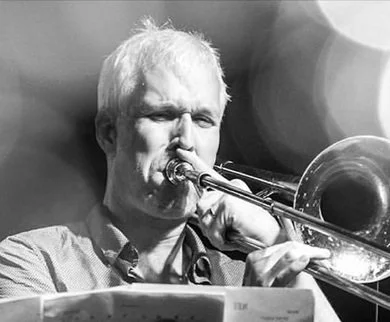
Dr Chris Stover
Chris Stover is a composer, improvising trombonist, and Associate Professor of Music Studies and Research at Queensland Conservatorium, Griffith University. He is author of Reimagining Music Theory: Concepts, Communities, Creativities (Routledge) and Timeline Spaces: Temporal-Relational Processes in African and Afrodiasporic Music (in press, Oxford) and editor of Rancière and Music, Making Music Together: Analytical Perspectives on Musical Interaction, and the Edinburgh University Press series Resonances: Critical Engagements with Music and Philosophy. His most recent album, Helical, was released in early 2026.
Queensland Conservatorium, Griffith University